
“Knock three times on the ceiling if you want me; twice on the pipe if the answer is no.”
I haven’t heard that song in years. Why is it rattling around my brain for the past 24 hours? Oh, wait! Maybe it did play on the 70’s channel I tuned in while driving last week. That must have been the trigger that gave me this earworm. But seriously, this song is basically unrelatable in my life, and yet, here I am writing about it, because it won’t leave me alone until I do something about it.
What’s the important message?
The song is about using codes to share information. In the song, it’s between two people who don’t know one another. The man reaching out from the upstairs apartment to the woman in the unit beneath him. He wants a simple yes or no answer, presumably so that he can continue his pursuit or move on. There’s no indication about her state of mind, or her life situation, other than that she likes to dance in her apartment. It’s not even clear that he knows what she looks like. He’s attracted to his imagined vision of her movements to the music and created an image of what their relationship could be. And that future is all in his head.
It’s a lot like many late-career employees’ view of retirement. They want to know if they can quit working for a living, sometimes at a particular date, or based on a pre-determined financial nest egg. Often, they don’t have any idea what their retirement will look like.
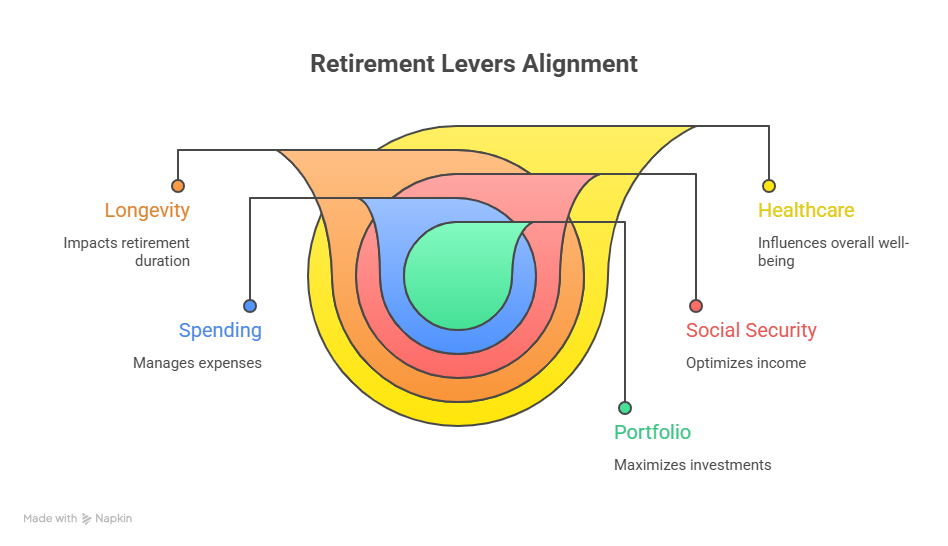
That’s because the decision is a lot more complicated than the finances, which are basically math applied to their situation. Ed and Vicki brought us all their financials: investment and banking statements, tax returns, Social Security estimates, property values and debts. We learned that Ed already outlived most of the men in his lineage, while both Vicki’s parents were still active into their 90’s. While they wanted to enjoy Ed’s perceived remaining healthspan, we adjusted levers to suit Vicki’s time horizon. Fortunately, she was the risk-taker of the two of them, so we could invest appropriately for the long term.
Frank and Uma had a similar financial profile, normal life expectancy concerns, and a desire to leave a financial legacy after they passed. Unfortunately, they wanted the impossible: a bullet-proof portfolio. There is no such thing as a bullet-proof portfolio. There are insurance products designed to make the fearful more comfortable, but in removing risk (aka volatility) from the investments, they also suck out most of the upside needed to outpace inflation. And just like personal relationships, once they get into them, they don’t always like the results. And Frank and Uma had to decide between the guarantees and their goals.
Now, to be clear, what the singer proposes is to get to the next level. It’s not something that couldn’t be reversed, although as neighbors, if the relationship goes bad it could get real.
Likewise, we think it is important to begin planning years before becoming financially independent. There are many issues besides the financials to work through. The most important thing is what will replace the 40 or more hours every week that you’re out of the house? Are you retiring from something you don’t enjoy, or are you attempting to move into a more fulfilling life than the one you’re currently occupying? How will you maintain sanity in your household? Will you get more involved in the community, your church, and your family? Are travel and hobbies high on your plans? Is today’s home a permanent place or not?
Whatever your goals, their costs can be estimated and worked into the lifestyle planning process, and that’s ongoing because life is not static. For most retirees, we talk about three distinct phases: the Go-Go Years, the Slow-Go years, and the No-Go years. And those phases are driven mostly by the individual’s circumstances. I did a blog explaining how fitness dramatically alters the relative lengths of those three phases. So we ask: “What are you doing to take care of yourself?”
When “Knock Three Times” topped the charts, we had AM radios in big gas-guzzling cars, the Apollo missions were still taking American astronauts to the moon, and we hadn’t ever seen a President resign in disgrace. Some say they were simpler times, but that’s just nostalgic reminiscence. Looking forward is always looking into the unknown.
During this time, the FED, led by then chairman Arthur Burns, used the monetary lever of lowering interest rates (aka “easing”) to help stimulate the economy, leading to job growth. Their actions had the unintended consequence of dramatically contributing to the stag-flation which would depress Americans for almost a decade.
Today we consume entertainment distributed by satellites so numerous that they’re calling it space junk. And we still think the FED can flip a switch to solve current or perceived economic problems. But the truth is that monetary policy (aka FED decision making) is just as opaque on the economic level as retirement planning is for the individual. Alan Greenspan had a legendary ability to see beyond the economic models, and the political savvy to use his insights wisely. And yet, he misjudged the risks inherent in the unregulated mortgage-backed securities markets and we spiraled into the Great Financial Crisis of 2008.
But regardless of the opaqueness of the future, like the man in the upstairs apartment, we must get to the next step in life. And that’s where Enduring Wealth Advisors® can be helpful. And it’s a lot easier to talk to us, just click our “Talk to an advisor” link and schedule an introductory call. I promise you won’t need to knock three times.
Research and development of this article involved AI tools.