
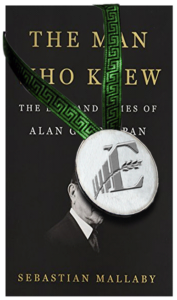
 The Man Who Knew
by: Sebastian Mallaby
Reviewed by: Ralph Bender, MBA, CFP®
Medal Rating: Silver Medal
I thought I knew Alan Greenspan. After all, I lived through his entire tenure at the Fed, watched him testify before Congress, and experienced the economic cycles he helped shape. Turns out, I didn’t know him nearly as well as I thought. Sebastian Mallaby’s “The Man Who Knew” reveals a far more complex and fascinating figure than the measured, almost robotic Fed chairman who appeared on our television screens.
Mallaby does an excellent job making the biographical details digestible. I came away understanding how Greenspan rose from a jazz musician to the most powerful economist in the world. What struck me most was that he was unusually smart in a particular way—he inherently understood the limitations of econometric models. While others became slaves to their spreadsheets, Greenspan brought wisdom to the data. More importantly, he connected the dots between the numbers and current events in ways his peers simply couldn’t.
His political adroitness was a genuine surprise to me. Maybe I wasn’t paying close enough attention all these years, but Greenspan carefully cultivated political and media relationships which he leveraged brilliantly in both his private life and his business. He wasn’t just an economist; he was a master networker who understood that influence required more than just being right about interest rates.
The personal details fascinated me equally. I had no idea that his mother was the most important woman in his life, and that he didn’t marry until after she died. Yet he openly dated strong, accomplished women during the prime of their lives—including Barbara Walters, and ultimately married television journalist Andrea Mitchell. There’s something telling about a man who gravitated toward powerful, intelligent women but couldn’t commit until his mother passed away.
Perhaps most revealing was the range of his economic viewpoints. Greenspan wasn’t the ideological purist many assumed. He evolved from a laissez-faire devotee of Ayn Rand to a big government bailout proponent when faced with crises and companies deemed “too big to fail.” In essence, his position depended upon the circumstances. Some might call that pragmatism; others might call it opportunism. Either way, it’s more nuanced than the narrative we were sold.
That Greenspan became the scapegoat of the Great Financial Crisis isn’t terribly surprising, given the timing of his retirement and the unraveling of the mortgage industry. Was he in charge when the crisis’ seeds were sown? Of course, and for that he’s culpable. Was he the one making predatory loans to people who couldn’t repay them? Of course not. But since he was the guy who just left the job, the people coming in to clean up the mess could conveniently point the finger at him. Never mind the fact that his two immediate successors were part of the team in charge under his guidance. It’s easier to blame the ghost than the people still in the room.
Fair warning: this is written for academic rather than casual readers. Mallaby assumes you understand the mechanics of monetary policy and won’t hold your hand through the technical details. If you’re looking for a light beach read, look elsewhere. But if you want to truly understand the man who shaped modern American economics—with all his brilliance, contradictions, and ultimate fallibility—this book delivers.
AI tools were used in the development of this book review.