
Two half marathons at two National Parks in two weekends?
Sign me up!
They call it the Grizzly Double. Grand Tetons one Saturday morning and Yellowstone the following. Do you know how hard it is to run at those elevations?
I mentioned the event to my wife, who mentioned it to her sister, and before I knew it, we’d planned a road trip. We routed through Zion National Park and added a few days at Bryce Canyon National Park where my sister-in-law wanted to get down into the canyons, to see the hoodoos from below. But medical conditions ruled out hiking.
And that’s how I met Maverick, the mule I rode 1,000 feet down to the Bryce Amphitheater amongst the rock formations, before returning to the canyon’s rim.
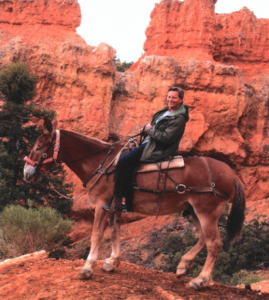 The wrangler told us to “trust your mule, they do this trip every day. Their instincts will keep you safe.” Did I mention that the trail is carved into the side of the canyon wall? You go maybe 20 yards, then the trail turns 180° back on itself as you go another 20 to 50 yards to the next switchback.
Maverick is one of the biggest mules in the train. His back, and therefore my butt, are nearly six feet off the ground. He’d prefer to walk on the outside edge of the trail, rather than next to the wall. So not only do I see the sheer cliff below us, I’m perched atop an animal I never met before, who likes to walk along the edge of a trail that drops straight down to the next switchback.
Did I mention that I’ve got a bit of vertigo? It’s not an overwhelming or disabling issue, but I tend to keep to the inside of a trail, closer to the wall than the edge. That makes me feel a bit safer.
But Maverick sees it differently. He doesn’t want to get too close to the wall. Mules are the offspring of a donkey and a mare, which makes them both intelligent and cautious — and better trail animals than either parent.
He knows where he is going; he’s traveled this trail almost daily for most of his life. He also knows that I don’t know much about riding a mule and probably never traveled his trail. And most importantly, once I relax into the ride, it’ll be easier on both of us. Maverick will be able to do his job, and I can experience the splendor that is Bryce Canyon.
Retirement is a trail you’ve never experienced. For many, it’s the best time of their lives, especially those go-go years when physical health is best. But the transition onto that trail, as well as the journey itself, is fraught with potential dangers. Questions like:
When should I claim Social Security?
How much can I spend every year?
Where can I see my investments and get my tax forms?
What if I need extra money we didn’t plan to take?
Do Roth Conversions fit in our situation?
Who is monitoring and adjusting my portfolio?
In a market panic, what keeps me from going over the edge?
Missteps can be costly, if not tragic.
Like Maverick, we’ve been down this trail hundreds of times and, as fiduciaries, we put your interests ahead of ours. With decades of experience comes the wisdom our clients rely on to settle into their next phase of life.
Unlike him, we know that each person’s experience and expectations are unique. Your goals and objectives drive the answers – we’re here to pace you through finding them.
In our jargon, retirement is called “distribution phase,” as money is typically getting sent out of your portfolio rather than into it. So, when you retire, you move from “accumulation phase” to “distribution phase.” Accumulation phase is the road trip to the canyon, while distribution phase begins when you get on the mule and travel a different road.
Sustainable distributions, protection against market risks, and preserving your future financial flexibility are the pillars of your distribution plan. You’ll likely try new adventures, or face new challenges, and by keeping you informed of your situation, you’ll have confidence in your choices.
At the outset of our journey together, it’ll take some time to get comfortable. Like my first couple of switchbacks aboard Maverick, when he pulled those 180° turns and I stared into the abyss below me, it takes a while to understand what I should and shouldn’t do. You should focus on those things that are truly important in your life, while we handle the trials of the trails you take. You’ll undoubtedly experience market pullbacks, corrections, and inevitably a bear market. Those are normal recurring events in our world. Our job is keeping you from going over the edge.
Riding on the back of a 1,000 pound four legged animal is not without its jarring moments. The step-by-step motion becomes background noise quickly, as should the daily media frenzy that bombards you. Maverick’s hoof sometimes slips, causing an unexpected motion. But he’s got three other legs holding me up. Your portfolio likewise has investments that will occasionally slip; that’s the point of diversification, having something else to hold you steady.
As we were coming back up the trail (after an amazing experience) the wrangler leading our group suddenly stopped the train. He was above me after clearing the next switchback. He dismounted and headed straight to Maverick. He saw that my saddle was slipping dangerously, and he made an adjustment.
Likewise, there may come a time that we’ll need to do a reset of your plan. Major life changes are the most common issues, but we had some resets during the great financial crisis and the dotcom recession, too. They don’t happen often, but when they do, a lifetime of experience coupled with our long-run working relationship can keep you on the trail.
Oh, by the way, I was first in my age group in both of those half marathons, and we all walked the Yellowstone 5k which was a personal victory for my sister-in-law.
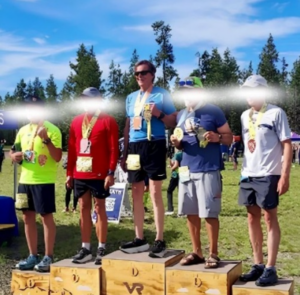 NOTE: Vacation Races hosts events adjacent to national parks, so Grand Teton was in Jackson Hole WY, while Yellowstone was in West Yellowstone MT. They are fun, but not super-competitive.
Research and development of this article involved AI tools.
Diversification does not ensure against market risk.